Saturday, June 25, 2022

CALL TO DISCIPLESHIP: WHAT IS INVOLVED

REFLECTION FOR 13TH SUNDAY OF THE YEAR – C

THEME: CALL TO DISCIPLESHIP: WHAT IS INVOLVED

R1: 1 Kings 19:16.19-21

R2:  Galatians 5:1.13-18

Gospel: Luke 9:51-62_

To be a follower is to imitate one’s example. Just as it is called, it demands coming behind the one who leads and learning from him. Being a disciple of Christ is like journeying with him through Jerusalem. The Jerusalem experience of Christ was not a pleasant one; since it was there that he was killed. As disciples, our followership involves similar experiences, which may push one to the wall in some circumstances. The gospel reading of today advices us on the attitude we must put up as Christ’s disciples. We have the following lessons:  


Openness of mind:

To be a disciple of Christ is a choice. As one makes a choice to be a follower of Christ, so too does others reject this choice. For those who reject, there is no need to abuse them or fight them. A disciple should be an open minded to interacting even with those who refuse to accept their faith. Jesus showed us this example by accepting to be the friend of sinners.

In the gospel, the Disciples of Christ requested to call down thunder on those who refused to receive Christ and Jesus condemned this attitude. In the same way, it is not our duty as followers to begin to fight those who do not follower our faith. Let us rather use our energy positively in a wonderful relationship and in an exemplary living and this will lead to the conversion of the unbeliever. However, they refuse to listen and to change and accept the faith even after many practical show of love, then redirect your energy to others, for there are very many who are yearning for the gospel. That was why Jesus had to leave for another village when the Samaritan village refused to receive him.


Disposition to face what comes:

 Many times and in different places people choose to become Christ followers so that Christ will supply all their material needs. No wonder it happens that many of those who are massively wealthy do not go to church because they feel there is nothing to ask God for. No wonder the Psalm says ‘in his riches man lacks wisdom’ (Psalm 49:20).

A challenging question that awaits all Christian is: what is your intention for being a Christian? What do I actually want to get for being a follower of Christ? If my intention is to have all my material needs supplied by Christ, then, I am at the wrong place for Christ does not supply all our material needs. While we follow him let us remember that, ‘Foxes have holes, birds have nest but the Son of Man has nowhere to lay his head’ (Lk 9:58) However, if our discipleship is prompted by our love for His kingdom, then, just like the birds of the air who neither sow or reap but have their food, the Lord will provide what we lack (Mt 6:26).


Self Denial:

 To be a follower of Christ is a great privilege. It is an opportunity that one must guard jealously to avoid losing it. To guard against losing this great opportunity one must let go of everything that will cause a hindrance on the way. Peter understood this when he left his net and followed. Other disciples left some other things and followed him as well. Mathew for instance left his noble profession of collecting tax. Elisha, in the first reading slaughtered oxen for his family, symbolizing that he is leaving everything for God’s work. What have I left to follow him? You, what have you left?

Jesus in the gospel tells us that once called, there is no going back. Once we have made the choice to become Christians, we have chosen to leave behind our past and to look up to God for the future. In this choice, there is no moment of recreation or free time, hence, to the man who asked that he be allowed to go and bury his father first, Jesus told, ‘Leave the dead to bury their dead’ (Lk 9:60). Therefore, we are being encouraged not to allow ourselves to be distracted by anything at all. That is why to the one who chose to follow him, he told; anyone who looks back after being called is not fit for the kingdom of God (Lk 9:62). 

*Rev Fr. Chukwuemeka VINCENT Livinus, SMMM.*

Sunday, June 19, 2022

THE HOLY EUCHARIST: CHRIST AMONG US

REFLECTION FOR THE SOLEMNITY OF THE MOST HOLY BODY AND BLOOD OF CHRIST- C

THEME: THE HOLY  EUCHARIST: CHRIST AMONG US

R1: Gen 14:18-20

R2: 1 Cor. 11:23-26

Gospel: Luke 9:11-17

Dear friends, today we celebrate the centre of our Christian worship; the Solemnity of the Body and Blood of Christ. This is a celebration of the saving passion of Christ through which we are sure of Christ’s continuous presence among us. Christ feeds us with His Body and Blood, encouraging us to do it in remembrance of Him. Our partaking of this wonderful meal assures us of salvation. The readings of today leave us with the following lessons about the Eucharist: 

1. The Eucharist is a Gift:

 Melchizedek, in our First Reading, was the king and priest of Salem during the time of Abraham. He presented the gifts of bread and wine to Abraham who was hungry as he returned from fighting the kings who had taken his nephew Lot, into captive. He blessed him afterwards. 

In our time, as Christians we no longer have Melchizedek but we have Christ who is present among us in the Eucharist, as both our king and the priest of the New Testament. He offers us His Body and Blood as food to quench our hunger, after being tired of a life without Him. He commands us to this in memory of him. 

“Do this in memory of Me”, implies that (a) we celebrate this mystery of His divine presence again and again. (b) We learn from the act of Christ’s generosity who freely GIVES us His Body and Blood as spiritual nourishment. Therefore, we should be pushed to share what we have received with the less privileged among us. Just as Melchizedek freely shared the bread with Abraham, we must generously share what we have with others.

2. The Eucharist is a Communion:*

 In Corinth, the church use to have a meal together before the celebration of the Eucharist. For participating in this meal, a separation was made between the rich and poor. The rich used to sit together while the poor were given a different place. St Paul in the Second Reading, clarifies that the institution of the Eucharist by Christ bridges this awkward behaviour of separation and brings together all peoples, for Christ who is broken in the Eucharistic bread is present as a life giver to all who participate in the banquette without any distinction. From the altar, we all eat the same bread and drink from the same cup, not different bread and not from different cup.  Hence, the Eucharist binds us together and while still on earth we unite even with those in heaven and expected to live like saints *_(N’oriri di aso, eligwe n’ala n’emekorita...)._*

In the Eucharist we celebrate Christ who is present among us, and when we eat this bread we become one with Christ. The implication is that whenever we receive the Eucharist we have accepted a responsibility to love as Christ loved and we should bring Christ to those who lack Him. Just as in the time of Abraham, those who ate the bread and wine of Melchizedek were pagan people of Salem, Children of Abraham and the Jews; these ate together without separation, the Eucharist does more by gathering us from different cultures at the table of God. As Eucharistic people, our participation abhors segregation and condemnation, therefore, communion without hatred, and with love.

3. The Eucharist initiates a Miracle:

 The Israelites, according to the Gospel Reading, followed Jesus to the desert so that they will listen to his teaching. There in the desert they were hungry and Jesus fed them.  Before the feeding by Jesus, He told his disciple, “Give them something to eat” (Lk 9:13).

We (Christians) like the Jews have left the land of slavery towards freedom. Through our baptism we have left worldly pleasures towards Jesus for salvation. As Christians, the centre of our gathering is no longer the desert but the Church where Christ feeds us with His Body and Blood as Spiritual nourishment for the journey towards freedom.

As we gather, there are those who need urgent attention in our midst, these represent the multitude that was hungry. Jesus is saying to us today, GIVE THEM SOMETHING TO EAT. This is a call to take care of every member of our community who needs urgent physical attention. If we can generously provide from the little we have then we shall experience the great miracle of multiplication where everyone will have enough for their need and not their greed. The greatest miracle will be that all those who have followed Jesus to the desert (Church) will at last have an eternal satisfaction in heaven. But before then, let us take care of one another.


*Rev Fr Chukwuemeka VINCENT Livinus, SMMM.*
Saturday, June 11, 2022

THE HOLY TRINITY IN HUMAN HISTORY

HOMILY FOR THE SOLEMNITY OF THE MOST HOLY TRINITY, YEAR C

THEME: THE TRINITY IN  HUMAN HISTORY


R1: Proverbs 8:22-31
R2: Romans 5:1-5
Gospel: John 16:12-15

Dear friends, last Sunday we celebrated the Pentecost, the outpouring of the Holy Spirit on the apostles through which they were commissioned to mission. Their mission was to preach the gospel and baptised those who believe in the name of the Father, and of the Son and of the Holy Spirit. Today we are gathered to celebrate this God of ours, who is one, in three persons; Father, Son and the Holy Spirit (Trinity). Our belief in the Blessed Trinity makes us different from other religions. This does not mean we believe in a God who is three, rather we believe that God is one but exists in three divine persons, Father, Son and Holy Spirit. This is a mystery beyond any human intellect. However, the readings of today make us to understand three major ways God manifests Himself as a Trinity in our history.

*1. AT CREATION:*

 God the Father is active in the creative work. The book of Genesis acknowledges that in the beginning when there was nothing, God created. His act of creation was accompanied by the presence of the Trinity, hence, God spoke and things came to be. John acknowledges that Jesus is the word of God, who has been with the Father from the beginning (John 1:1). And the divine wind (spirit of God) was hovering on the face of water at creation. The presence of the Trinity led to the creation of a beautiful world.

The first reading from the book of Proverbs explains that God from the beginning begot wisdom before he created. This wisdom was inseparable by His side and was the master’s craftsman throughout creation. WHO IS THIS WISDOM? Jesus is the wisdom of God (1 Cor. 1:18-2:16).Hence, Jesus was present throughout the time of creation. John noted this when he said, “Through him all things were made” (John 1:3). After the creation of man, God breathed on man and he became a living being, and God made him master of all things created and to remain in union with him (Gen 1:26;28; 2:7). However, out of disobedience, man lost the initial friendship with God.

*2. AT SALVATION:*

Upon man’s disobedience, God never abandon mankind to their fate, He came down from heaven in the person of the Son, and through the power of the Holy Spirit He took flesh to dwell among us, encouraging us to follow the right part so as to unite with Him again at last in the garden of God’s kingdom.

Through His Son, God has granted us grace, that professing our faith in the Him we may be saved. Hence, the second reading points out that the grace we receive from the Son justifies us as children of God. Through grace we are being baptised and initiated into this divine relation of being children of God. As children of God, we have to preserve in faith through many trials. Being strengthened by the Holy Spirit, we have a sure hope our final destiny, which is the union with God. The possibility of our union with God lies on our acceptance of Jesus and his word. The word of Jesus are not just his own but the word of the Father, therefore, whoever believes shall have his sins forgiven and shall have eternal life (Acts 10:43, John 3:15). Sometimes, we face challenges and difficulties in accepting and practising the demands of the gospel, hence God sends us the Holy Spirit. 

*3. IN UNIFICATION:*

The Holy Spirit makes things clearer to us. When the apostles were afraid to preach the gospel, the Holy Spirit cleared their doubts and made them fearless preachers of the gospel (Acts 2:1ff). Through the power of the Holy Spirit, the Ethiopian eunuch understood the scripture and was converted (Acts 8:26). It is the Holy Spirit that makes us push higher and to aspire for the greater good and do it while avoiding evil. With the good we do we are sure of our final destiny, we are sure of meeting God our Father.  It is through the power of the Holy Spirit that we call God, Abba (Father) Gal 4:6.

Dear friends, it is clear that the Blessed Trinity has always been present through our history. He calls us to a special relationship with Him. This relationship is what we have accepted through our baptism and strengthened through our reception of the Holy Eucharist and Confirmation.  With our baptism and confirmation, we are convinced of the truth of God’s plan for us. This divine plan started from creation, the plan that we should unite with Him forever. This divine plan has a process that should be followed. This process is the way of Christ, following keenly his example. One of the essential things is that God is love and the Holy Trinity is a simple of love and togetherness.  We are therefore encouraged to follow the example of Blessed Trinity by remaining one in love as Jesus prayed. Let us put aside our apathy, our differences and work together as sons and daughters of one God, knowing that we are all heading to one heaven.

Rev. Fr. Chukwuemeka Vincent Livinus, SMMM

Saturday, June 4, 2022

THE PENTECOST AND THE NEW CHURCH

HOMILY FOR PENTECOST SUNDAY YEAR C

THEME: THE PENTECOST AND THE NEW CHURCH

R1: Acts 2:1-11, 

R2: 1 Cor. 12: 3-7; 12-13, 

Gospel: John 20: 19-23

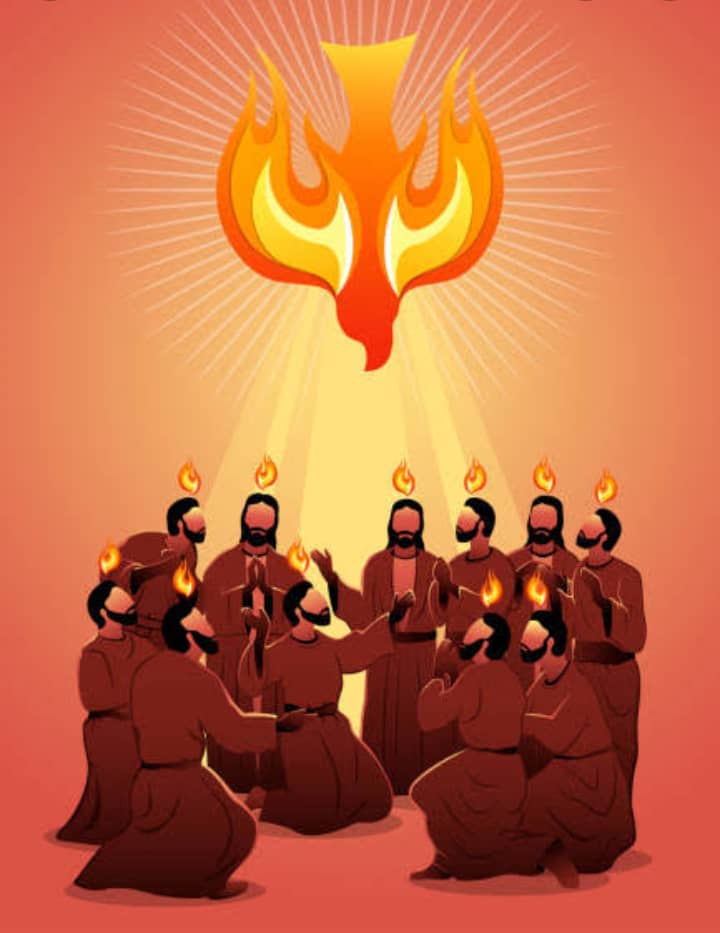
Dear friends, it is Pentecost. Today Christ fulfils his promise of sending the Holy Spirit to his disciples, to equip them for the work of spreading the gospel. Today, Christ fulfils the promise of not leaving his disciples as orphans. The Holy Spirit opens the doors that were shut by the disciples because of fear and gives them courage to proclaim the gospel fearlessly. On this day, Christ breathed a new breathe of life on his disciples making them a new creation, a people endowed with a divine character to forgive or to retain sins. The first reading of today describes fully what happened: (a) On the day of Pentecost (b) The disciples where all in one room (c) They heard a thunderous sound like a mighty mind (d) Something like tongues of fire rested on their heads...they spoke in foreign languages. These are wonderful symbolisms that need explanation.

*1. The Pentecost Day:*

 ‘Pentecost’ has a Greek origin, meaning fifty (50). The Pentecost was a Jewish celebration in remembrance of their arrival at Mount Sinai and their reception of the law from God, through Moses. This celebration was a remarkable one among the Jews since the Law was held in high esteem among them. Proud of their reception of the law directly from God, this feast was introduced in thanksgiving to God. 

According to the Acts of the Apostles, it was on the day of the feast that the Holy Spirit descended on the disciples. This has a deep and symbolic implication. Since the Jews hardened their hearts towards keeping the old law, the decent of the Holy Spirit on this day is a substitute for the old law. This becomes a new dispensation and a fulfilment of the prophecy of Ezekiel, “I shall give you a new heart and put my spirit within in you; I shall remove the heart of stone from your bodies...I shall put my spirit in you and make you keep my laws (Ezk 36:26, 27).  The Holy Spirit is the new spirit which changes the hardened heart of the Jews, making the receivers of the spirit productive.  With the reception of the Holy Spirit, external laws become unnecessary because the law is now implanted in the heart of God’s people. When the law is written in the hearts of God’s people, they become no longer hardened but fruitful. 

*2. The Sound of a Mighty Wind:*

 In the book of Exodus, the Israelites gathered at the foot of Mount Sinai for the reception of the law, and these signs: peals of thunder, lightening, a heavy cloud and a loud trumpet blast (Ex 19:16), accompanied the reception. The decent of the Holy Spirit was accompanied by similar signs as well.

On the Pentecost day, instead of gathering at the foot of Mount Sinai, the apostles gathered together in a room. This room represents the Church, through which God communicates the new commandment, the commandment to love, love that is forgiving. Similar signs accompany the translation to this new spirit of love and forgiveness instead of revenge as in the old law, hence, sound of thunder at Sinai now becomes the sound of a mighty wind, flashes of light now becomes tongues of fire, the fear of the Israelites now becomes the courage of the disciples who preached fearlessly. The disciples in the room where the sole beneficiary of this spirit of God, hence, it is only through the Church that God dispenses this new spirit of mercy. 

*3. Speaking in Tongues:* 

According to the Acts of the Apostles, the reception of the Holy Spirit was accompanied by speaking in foreign languages by the disciples. It is strange to read that the foreign languages spoken by the disciples were understood by those who stood by. What does this mean?

Dear friends, Christianity is not limited to certain people, this is indicated by the different languages spoken by the disciples. Having replaced the old law, the gospel is for all people and not just for the Jews. Those who gather in the room (Church) should allow themselves to be transformed by the Spirit of God and should speak the language everyone understands. Which language is that? The only language that when spoken everyone understands, is love. Love does not change, it remains the same in all cultures and that is why John said, God is love (John 4:8) because God does not change. Following St Paul, Christians, having been baptised with this fire of the Holy Spirit, must speak this language without reservation by using their different gifts and talents as parts of the body to work for Christ who is the head of the Church. This is the spirit we were all baptised into, Jews and Greeks alike (1 Cor. 12:12, 13). 

We ask the Lord, to send forth His Spirit and renew the face of the earth, Amen._

Reflection by

Rev Fr. Chukwuemeka V. Livinus, SMMM.

Saturday, May 28, 2022

THAT THEY MAY BE ONE

REFLECTION FOR 7TH SUNDAY OF EASTER, YEAR C

THEME: THAT THEY MAY BE ONE

R1: Acts 7:55-60

R2: Rev 22:12-14; 6-17; 20, 

Gospel: John 17:20-26_

Dear friends, today is the last Sunday before the Pentecost, when we shall receive the Holy Spirit. The Holy Spirit is the principal agent of mission; with the reception of the Holy Spirit, the apostles began a fearless proclamation of the gospel just as we become true witness of the gospel and soldiers of Christ by our reception of the Sacrament of Confirmation. As we go about proclaiming this gospel of Christ, He prays for us (Christians) for dispensers of the gospel and those to whom the gospel is being dispensed. His prayer contains His wish, *“...that they may be one”,* (John 17:20). The unity of Christians forms the basis of today’s reflection. Unity is what we must embrace if we must preach the gospel and if we must win souls for Christ. We have the following lessons to learn from the readings.

*1. The Source of Christian Unity:* 

The basis of Christian unity is the Trinity. We become Christians after we are baptized in the name of the Trinity; Father Son and Holy Spirit. The Trinity is a symbol for Christian love. When we are baptised, we are commissioned to love, for God is love and love is the character of God. Baptism makes us Christian, Christ-like, God-like, hence, love is identical with our Christian character and without love there is no Christianity. 

In the gospel reading of today, Jesus prays, ‘that they may all be one . . . *EVEN AS WE ARE ONE’* (Jn 17:21.22). Jesus, in this prayer opens up for us the reality of the Trinity. ‘Even as we are one’, indicates the unity of Persons in the divine Trinity. ‘That they may be one’, is an invitation to follow the example of the Blessed Trinity, meaning, that they may love themselves as We (the Blessed Trinity) exists in love. This is the hallmark and the summary of Jesus’ teaching, “love of God and love of neighbour” (Mark 12:30-31). To love God is to love His word even when it doesn’t go favourable with our ideology and when it challenges our weaknesses and limitations. It is also to love His ministers who are the dispenser of this message. This was what the Jews and council failed to grasped when Stephen preached in the first reading, hence, they killed him. 

Dear friends, the Word of God may not always be pleasant to our taste and may not always be what we long to hear, let the love God help us to be docile always to accepting this reality especially when it becomes difficult, ‘for nothing good comes easy’ and let us not begin to compromise the truth of the gospel just to win the admiration of people and to seek our personal interests.

*2. The Fruits of Christian Unity:*

 Some time ago, an old man while approaching his death summoned his children and when they have gathered, he gave them a bundle of broom to break. As they tried after turns, they found how difficult it was to break it. Then, he gave them a stick of broom each from the bundle of the broom to break and it was very easy for the children to break the stick of broom. And he told them, “When you are united as this bundle of broom you will always succeed and you can make great achievements in life, but if you are scattered, each like the single stick of broom, you cannot achieve anything and it will be easy for the enemy to penetrate and destroy you.

Jesus, in the gospel reading says something similar to the action of this old man approaching his death. “...if they are one, the world will know the Christ you have sent and they will know that I have loved them as much as you love me” (John 17:22-23). 

Dear friends, we cannot invite people to our homes when we have set our house on fire, they will never come. People will gladly love to visit us even without our invitation when they know that we are very peaceful and friendly. Hence, the best way to preach Christ is by living well and together in love, with one mind and one heart and sharing things in common; this is the meaning of communion, and this will attract followers to Christ more than anything. They first Disciples of Christ were called Christians because they were Christ-like. Their attitude was what won the admiration of so many people who came to believe in the gospel (Act 11:26-27). We can do likewise. Let us live together and set aside our apathies and differences. ‘Together we can.’

*3. The Threat to Christian Unity:* 

In the story of the dying old man and his children as in above, the size of the broom he gave to his children will determine the volume of dirt it will sweet. The bigger the broom, the bigger the dirt it sweeps. The size of a book will also determine the energy one needs to put in reading the book. In the same way, the more united we are, the more challenge we shall face.

Dear friends, one may begin to ask why the Church faces many attacks and criticism in different ages and times. It has been proven that the Church is the most united and organised institution in the world. It is not surprising then that she faces these threats in different ages. In certain times, scientific development has threatened the Church to compromise the truth of the gospel and change some teachings which may not be fitting to some individual ideologies. Those who find no meaning in the teachings of Christ most times break away from Church and found their own churches. Others have stopped going to Church because they want the Church to preach what will favour them. In some circumstances, priests and ministers have been arrested, some imprisoned, some others killed for preaching the truth. This was the experience of Stephen in the first reading of today; persecution for preaching the gospel.

One common saying holds that *truth is bitter.* Being aware of this reality, let us not compromise the truth of the gospel or run away from preaching the truth, come what may, after all, we must all die some day. We should rather remember that Jesus will come again and very soon as read in the second reading. His coming will be to reward everyone according to what one deserves and what we preached (Rev 22:12-13). 

My friends, Christ has revealed to us everything we need to know so that we can participate in the mutual love of the Blessed Trinity. By this his prayer, he has made known to us that the nature of the Trinity is oneness (I have made known to them your name). This statement fulfils his word in Mt 11:27; “No one knows the Father except the Son and whom the Son chooses to reveal Him.” He continues to make known his Father’s love to us through the Church, which he has promised to be with always, “I am with you always till the close of age” (Mt 28:20). Now that we have known God and His nature, let us emulate this divine character for that is the fulfilment of Jesus’ demand, “Be perfect as your heavenly Father is perfect (Mt 5:28).

*Rev Fr Chukwuemeka Vincent Livinus, SMMM.*

Saturday, May 21, 2022

CHRISTIANITY AND CULTURAL EQUITY

HOMILY FOR 6TH SUNDAY OF EASTER, YEAR C

Theme: CHRISTIANITY AND CULTURAL EQUALITY

R1: Act 15:1-2.22-29, 

R2: Rev 21:10-14, 22-23, 

Gospel: John 14:23-29

Dear friends, last Sunday, Jesus, while with his disciples on the last supper told us his last wish; “Love one another.” Our love for one another will be the proof of our being his disciples. Today is already the 6th Sunday of Easter and we are confronted with the reality of Jesus’ departure from the world as he makes clear his intention to ascend to his heavenly Father. With the end of Easter, our attention will be shifted from practicing what we have learnt from him, the risen Lord, to how we shall relate with our neighbours. With the Lord’s physical absence from the world, we are to continue preaching the good news. As we go about this, we are expected to bear in mind the following lessons:

*1. Religious Equality:* 

The first reading of today presents us with the challenge faced by the early Christians.  The early Christians were made of two groups; those who had Jewish origin and those who had a pagan origin. The relationship between this two groups was not a smooth one. Those of the Jewish origin considered themselves  better Christians because of their circumcision. They insisted that  those of pagan origin or none Jews must be circumcised if they are to be Christians. This problem led to the first Jerusalem Council where the disciples decided that circumcision is not a necessary requirement for being Christian.

This speaks to all of us directly.  Sometimes we may feel that we are better than others, based on anything. Sometimes we  refuse to love others because they have a different ideology. Sometimes we  consider ourselves as the best while others are not important.  These are similar to the actions of the Jews.  However, let us know that in Christ, there is no cultural differences. No one is better than the other. The ritual observance of a particular rite does not make us better than those who have different views of life.  Let our priority be to do the will of God. This is what makes us better. 

*2. The Kingdom of God unites all believers:*

To unite with God on the last day is the desire of every Christian. Sometimes  the tendency to limit the kingdom of God and its realization to a  certain geographical location manifests itself in what we say and how we act. In the second reading of today, John gives us  a picture of what we should expect in the Kingdom of God.

In his vision,  the holy city comes from God. It has twelve gates; three on the east, three on the west, three on the north and three on the south. In that city, there was no temple and the city needed not the sun or moon for the radiant glory of the Lord lighted the city.

Friends,  God has made salvation a universal course. There are various ways through which we can go to heaven. The way to the kingdom of God is not limited to certain vocation or way of life just as a priest and religious can go to heaven, others who do other works can go to the same heaven through the way they live. First, this kingdom  is a gift from God to those who love Him.

The different gates from the four corners of the world (east, west, north and south) indicate that the kingdom of God is not limited to a certain culture or a certain group of people. There are different ways and through which one can make effort to attain this kingdom. 

*3. The Peace the World cannot give*

With the reality of the absence of Jesus which will confront the disciples in a very short time,  Jesus prepares their minds on how to overcome that challenge.  They are to remain in his love and their love for him is a direct love for the Father. Whoever loves him, God will make his home in him.

Dear friends, with the ascension of Jesus, Christians are to continue preaching the good news. To preach this, one must be exemplary in his life. Such a person must be Christ-like. The prove that God lives in us is that we do the work of God, just as Jesus' work indicated that he is in communion with the Father (Jn 10:38). 

It is those who remain in his love that he will send the Holy Spirit to fortify them in times of difficulty. The Holy Spirit makes the work of God easier and activates us for proper missionary function.

One who remains in God's love,  experiences the peace that the world cannot give. The ultimate peace is the gift of the kingdom of God which the world cannot give.

Dear friends,  let's us not loose hope, heaven awaits those who trust in God. Let's us discriminate,  we are all  the children of the same God, heading towards the same heaven. Let us pray that many who do not believe may have have a change of heart and turn towards God. 

Fr. Chukwuemeka Vincent Livinus, SMMM

Saturday, May 14, 2022

LOVE ONE ANOTHER

REFLECTION FOR THE 5TH SUNDAY OF EASTER, YEAR C

THEME: LOVE ONE ANOTHER

R1: Acts 14:21-27, 

R2: Rev 21:1-5, 

Gospel: John 13:31-35_

Traditionally, the last words and will of a dying person are usually being taken seriously. The readings of today are built on the stage of last wish and end time.  In the first reading, Paul and Barnabas, approaching the end of their first missionary journey, being moved by love visited the communities they had founded to encourage them. The second reading gives us a picture of beautiful city we shall dwell in at last if we persevere in our love for God till the end. In the gospel, Jesus, just before his agony and passion gives us his last wish: “Love one another,” this will be the sign by which we shall be known as his disciples.  The central theme that runs through the three readings is, “LOVE.”Love is one of the most mentioned words daily. Its application and usage always differ from people’s understanding. However, the readings of today clarify Jesus’ intention. Therefore, we have the following lesions:


*1. Love: The Hard Truth:*

 In a time and in a world where the word “Love”, has been bastardised and where we may not want to offend our loved ones by telling them what they may not want to hear, the first reading of today clarifies Jesus’ intention of love one another and what we must do.

The disciples; Paul and Barnabas, having established some Christian communities, and these communities having experienced the tremendous works and miracles accomplished through these peoples, told them the hard truth, “We all have to experience many hardships before we enter the kingdom of God” (Acts 14:22). This is the reality many people would not want to hear.

It is common to tell our loved ones sweet things and sweet words, however, avoiding telling them the reality of how things are means we do not understand fully the meaning of love. Love is leading our friends to the truth, that, even though we may experience many good works from God as the early Christian communities did, we should also be ready to face the other side of the coin; persecution, hatred, rejection faces, betrayal and even hardship. These things surely accompany our discipleship. When we profess this truth, we are encouraging and preparing our loved ones for the journey ahead, that, nothing good comes easy, that the road to success is never easy and that it is only after the cross that the crown will come. This clarifies one of the intentions of Christ, and the aim is for us to persevere in faith.


*2. Love: The New World:*

 It is the dream of everyone, both Christians and none Christians to have a world where we shall experience an absolute peace, free from corruption, war, violence, sickness, natural disaster and so on. The second reading of today tells us that such a world can be possible and this possibility has a divine connection, “I saw the holy city...coming down from God” (Rev 21:2).

This vision of John presents before us two possibilities, the vertical and the horizontal.


 *(a)The horizontal possibility:*

 we can attain this beautiful city ONLY when we truly display the character expected of us as Christians, that through which a disciple of Christ is known. This character is love. Love is the only the thing that can make things have a new look. When love is active, what are rotten will spring up to new life.  If we love others the way we love ourselves then there will be no war, violence and corruption in the world. The love that can make this possible is that love that is sacrificial. It is the love we give without expecting anything in return. Putting up this attitude of love is the understanding of the biblical verse that God lives among human being and He will make His home among us (Rev 21:3). And this is the fulfilment of the new commandment, love one another. It is this condition that will make us Disciples of Christ (Jn 13:35). Love is the badge we must wear. It is the identity we carry. It is the image of God upon which we are created.


 *(b) The vertical possibility:* since the horizontal dimension may be difficult because of the dubious nature of mankind, since we sometimes receive the opposite of the love we give out to others, it is God who will reward all those who have been faithful to following this His command to love even when it hurts. The reward will be, a new city, the heavily Jerusalem where our sorrows and pains will be wiped away. There, all the things we pass through for being His lovers and dispensers of love will be forgotten and we shall become the people of a new creation.

May God help us to be true dispensers of love, through Christ our Lord, Amen.

*FR CHUKWUEMEKA VINCENT LIVINUS, SMMM.*

A DISCIPLE’S CROSS

REFLECTION FOR 22ND SUNDAY OF YEAR A THEME: A DISCIPLE’S CROSS R1: Jeremiah 20:7-9 R2: Romans 12: 1-2 Gospel: Matthew 16: 21-27 Dear friends...